Saturday, December 31, 2016

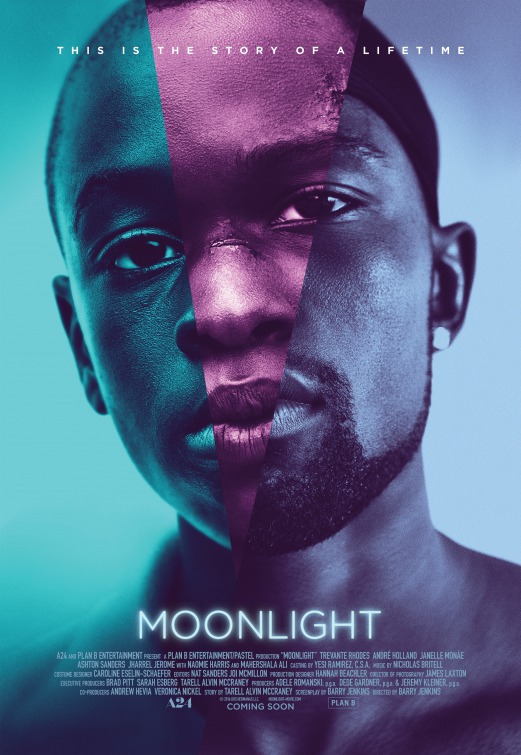
OSCAR WATCH: Moonlight


In a banner year for black narratives in cinema, there's no doubt that the crown jewel is Barry Jenkins' "Moonlight", an undeniable frontrunner for Best Picture, Best Director and Best Adapted Screenplay. This gem of a film is a beautifully wrought saga that achieves the rare feat of being both high art and captivating storytelling. Indeed, it's a standout in the black cinema canon, destined to be a considered a classic by future generations.

"Moonlight" is the coming-of-age story of a boy named Chiron. Shy and insecure, he struggles to fit in within the confines of his rough urban Miami community. His mother Paula (Naomie Harris) is a crack addict, his father is absent and he is constantly bullied at school. And in the midst of all this, he is also coming to terms with his sexuality as a gay man. Thanks to a supportive group of friends however, he manages to endure through the hardships. In particular, his fondness for childhood friend Kevin blossoms into lifelong affection. But the pressures to conform takes its toll over the years, threatening to prevent him from realizing and accepting his true self.

Chiron's self-actualization takes on novelistic proportions as we follow him through three pivotal stages of his life. Seamlessly portrayed by three gifted young actors with the aid of some astounding editing (if this film doesn't get a Best Editing, nod it would be a crime), the film has the scope of a grand epic. Yet Jenkins stays true to his modest indie roots, briefly checking in with the character for some of the defining moments of his life.

Though "Moonlight" is a film about the black experience, urban masculinity and the LGBT struggle, it conveys these themes without being emphatic about it. Indeed, perhaps the most impressive thing about Jenkins' elegant directing/writing style is how trusting he is of the audience. He doesn't need to show us the gun violence to instill a sense of danger, neither does he rely on explicit nudity or sex to make us understand the sexual underpinnings of Paula's desperation or Chiron and Kevin's intimacy. And you don't need to see characters behind bars to understand the cycle of mass incarceration that plagues this community.

This subtle approach is undoubtedly a risky gamble that feels all too rare for black cinema (especially when you consider the history of blaxploitation) and may not satisfy some viewers. But where the film lacks in plot specifics, it more than makes up for in stylistic flourishes. The film features expressive cinematography from James Laxton (worthy of a Best Cinematography nod), capturing mood, tone and story through revealing closeups and symbolic use of color. Likewise, Nicholas Britell's masterful score (a dark horse Best Original Score contender) reverberates with evocative instrumentals and choice song selections. You can practically sum up the film's themes through the introductory "Every N****r Is a Star" and the transformative use of Jidenna's "Classic Man".

All these elements create the film's artistic greatness, but what really captivates the audience are the authentic, powerful performances of its richly defined characters. In the film's most dynamic peformance, Naomie Harris (a certain Best Supporting Actress contender) is perfectly high strung as a troubled woman struggling to express her complex love for her son. As her surrogate is Janelle Monae, who fully embodies motherly kindness, living up to her character's name (Teresa). And by her side, Mahershala Ali has deservedly earned Best Supporting Actor plaudits for his performance as the wise but flawed father figure.

But ultimately, it's all about Chiron and Kevin, played marvelously by different actors in their childhood, teenage and adult years. Their palpable chemistry is the pining heart of the film, particularly between Trevante Rhodes and André Holland in the final act. Rhodes perfectly captures the various facets of Chiron's character, with a hardened exterior that melts away in Kevin's presence. Meanwhile Holland is effortlessly seductive and enigmatic as Kevin. Together they are the final grace note in the bittersweet ballad of Chiron and Kevin. And it's one that I'll surely be playing again in the future.

Monday, December 26, 2016

REVIEW: My Life as a Zucchini


With a title like “My Life as a Zucchini,” you’d be forgiven for thinking that Claude Barras‘ new animated film would be a happy-go-lucky story with talking vegetables. But you would be sadly mistaken. Barras takes animation down rarely trod paths with this heartrending film centered around children dealing with issues surrounding death, depression and abandonment.

Read more at The Awards Circuit

REVIEW: Barry


Let’s face it, if you’ve held or have run for a major political office, someone is going to make a movie about you. Whether for good (“Lincoln”) or bad (“Game Change”) reasons, cinema and television is obsessed with the lives of politicians. It’s therefore fitting that this year gave us not one, but two films about the history-making President Barack Obama as he completes his final term. In the summer we were gifted with the endearingly romantic “Southside With You,” and now Vikram Gandhi brings us the equally compelling “Barry,” exploring Obama’s formative years at Columbia University.

Read more at The Awards Circuit

REVIEW: Fire at Sea


A woman sits with her grandson by a window, peacefully sewing as thunder roars outside. She explains to him that it reminds her of a stormy fishing trip his grandpa once made during wartime. As naval ships fired rockets, she says it looked like there was fire at sea. For most filmmakers, this anecdotal story would seem to be unimportant, probably to be discarded on the cutting room floor. But for Gianfranco Rosi, it gave him the title for his latest award-winning documentary “Fire at Sea,” an uncommonly observant film.

Read more at The Awards Circuit

OSCAR WATCH: Hacksaw Ridge


It's been quite a year for "judging the art, not the artist". From Nate Parker, to Casey Affleck, to Woody Allen, Hollywood seems to be nearing a tipping point in how we approach celebrity in the social media age. This is certainly a question that is being asked in relation to Mel Gibson, whose past indiscretions have not prevented him from making another riveting film in "Hacksaw Ridge". As if to remind his fans of why they loved him before, this war epic recalls "Braveheart" while also exploring some new themes for the genre.

Based on a true story, "Hacksaw Ridge" follows Desmond Doss (Andrew Garfield), a homegrown country boy from Lynchburg Virginia. Growing up with his parents and his brother, he is brought up with firm Christian values. And one day, a traumatic incident occurs that reinforces his beliefs, especially with regards to violence and the Sixth Commandment (Thou shalt not kill). Years later as a young adult, his stance is put to the test. World War II is raging in Japan and young men are encouraged to enlist. Feeling a sense of duty to his country, Desmond decides to sign up as a combat medic, much to the disapproval of his father (who understands first-hand the dangers of the battlefield). The only catch is that he refuses to carry or use any weapons as a conscientious objector. Of course, his philosophy doesn't sit well with his army superiors. But Desmond remains undeterred, vowing to contribute to the cause by saving as many lives as he can.

As a romance, war epic and courtroom drama, Gibson delivers classic big-screen spectacle with this comeback film. And impressively, he gives all of those story elements their due weight. A large chunk of the film is used to establish the Desmond character with his backstory particularly underlining the circumstances that influenced the protagonist's strict moral code. Likewise, a meet-cute beautifully blossoms into a relationship, further emphasizing his loving nature. By the time the film moves to Japan, we therefore have a full understanding of Desmond and the psychology behind his subsequent actions.

And action is certainly what we get in the latter half of the film, as Gibson finds his comfort zone with terrifically executed battle scenes. Staged with visceral intensity and unflinching violence, he never backs down from the horror of war, making the eponymous Hacksaw Ridge into an ominous hellscape. It's easy to see why Gibson has attracted so much attention in the Best Director Oscar race.

But his approach isn't perfect however. The film's big emotional beats are often overwrought, lingering too long with swelling music. Even a mere pre-war kiss is played like the climax of the most sweeping romance drama of all time. And Gibson doesn't trust Garfield's committed performance to inherently show the character's tremendous courage and heroism. You could also argue that for a film which highlights compassion during wartime, its depiction of "good vs evil" leaves little room for nuance. But that would oppose the script's honest character study, as Doss' interest in the war was guided by that same principle. Still, it's the rare film of its ilk that doesn't celebrate toxic masculinity as a virtue, redefining the traditional concept of bravery.

Ultimately, "Hacksaw Ridge" thus emerges as a success through its sheer entertainment value, with enough thoughtfulness to appease more discerning viewers. And don't be surprised if Academy voters think so too, showering it with nods for Best Picture, Best Actor, Best Adapted Screenplay, Best Editing, Best Sound Editing and Best Sound Mixing. Indeed, the film will likely bring back fond memories of films like "Saving Private Ryan" and Gibson's own "Braveheart". Enough to make them say "they don't make 'em like they used to." Or at the very least, like Mel used to.

Thursday, December 22, 2016

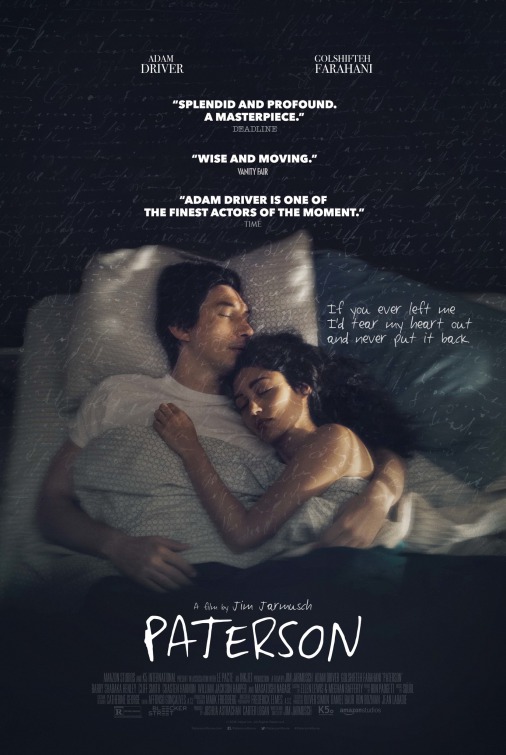
REVIEW: Paterson


The year 2016 delivered fulfilling cinema experiences, but I'd argue that you won't find any as rich as Jim Jarmusch's "Paterson". To quote the awards campaign tagline for "The King's Speech", some movies make you feel. "Paterson" is one of them. This quiet drama radiates warmth and comforts you like a cozy blanket.

Appropriately titled, "Paterson" refers both to the name of its protagonist (played by Adam Driver) and the New Jersey city that provides the setting. It takes place during the course of one week in this bus driver's life, as he goes about his daily routine, waking and returning home to his beautiful wife Laura (Golshifteh Farahani). His days are also filled with poetry, as he draws inspiration from his environment to write in his notebook. Paterson is content with this simple yet satisfying life. Still, Laura - an aspiring country singer/artist/designer/cupcake-maker - hopes some of her own ambition will rub off on him, encouraging him to publish his poems. But only time will tell where the winds will take him.

With a pair of main characters interested in art and the plot's reliance on poetry, it would be understandable to levy the "pretentious" label on the film. Indeed, Farahani's supposedly struggling artist character is literally a dreamer with seemingly no worries in her life. Furthermore, the pacing is decidedly leisurely.

And yet, "Paterson" never strikes a false note. Far from a manic pixie dream girl, Farahani's makes Laura feel so real. She has a calming presence that feels absolutely sincere and conveys genuine kindness. And her sincerity fits perfectly into a screenplay that surprisingly never reaches for lofty existentialism. What Jarmush accomplishes instead with his minimalist screenplay, is a wonderful slice of quaint small city life.

Most crucial to the film's success however, is Adam Driver's pitch-perfect performance as Paterson. As a compulsive people-watcher, he is an ideal window into this world. We experience all the sights and sounds alongside him, witnessing snippets of what could be standalone film narratives happening all around him. As he encounters scorned lovers and chatty teens, the film invites us to ponder the comedy and poetry of everyday life.

Simply put, "Paterson" is a precious film. And in its own effortlessly bittersweet, life-affirming way, it reminds you to appreciate the little things in life. Unlike more showy films, its modesty is its greatest strength. Like Aristotle said, the whole is greater than the sum of its parts.

Wednesday, December 21, 2016

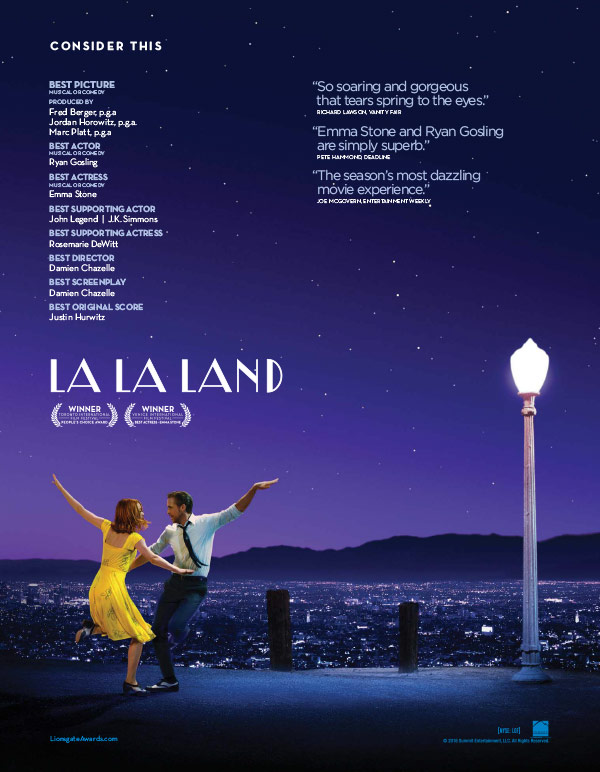
OSCAR WATCH: La La Land


"Is it too nostalgic? Are people gonna like it?" Such is the worry of actress and playwright Mia, as she prepares her one woman show. But this line in Damien Chazelle's "La La Land" could also be anticipating the inevitable critical response to this film. Indeed, Chazelle goes unabashedly retro in this delightful musical set in the city of stars.

"La La Land" is the story of Mia (Emma Stone) and Sebastian (Ryan Gosling), a pair of struggling artists trying to make it in Los Angeles. The former is an actress going from audition to audition with little success. The latter is a jazz musician with bigger aspirations than the generic lounge tunes he's stuck playing. By sheer serendipity, the two seem to constantly run into each other, until eventually decide to date. But will their love survive as they pursue their dreams?

And as Chazelle charts the course of their romance, "La La Land" proves to be a great showcase for his growth as a director. Interestingly, many mistook his breakthrough film "Whiplash" as his debut feature. But upon viewing "La La Land", it's clear that his actual debut "Guy and Madeline on a Park Bench" is the truer reflection of his directorial voice. That modest 2009 film was a charming musical romance that hinted at his old-school sensibilities, for which he will now be widely known for.

Of course, the Damien Chazelle of 2009 has evolved over the years. Now armed with a bigger budget and two of Hollywood's brightest stars, he has produced a grand, gorgeous ode to classic Hollywood and music. From the very first opening moments with its vintage CinemaScope title, "La La Land" recalls the great musicals of yesteryear. Scene after scene brings pure joy, with lovely original songs from Justin Hurwitz and breathtaking cinematography that casts Los Angeles in an inviting glow. And these scenes are fluidly edited, making the film feel as light on its feet as its two stars.

Speaking of the two stars, Emma Stone and Ryan Gosling really nail down the magic of classic Hollywood. In a role she was born to play, Stone puts her wide-eyed expressive face to good use, conveying all the necessary effervescence and vulnerability required. She's simply fantastic. Meanwhile, Gosling is a slick, cool cat as Sebastian, bringing effortless charm.

As Stone and Gosling sing and dance to their - and the audience's - hearts' content, "La La Land" sweeps you up with giddy delight and the cinematic beauty on display. As such, Oscar noms for Best Picture, Best Director, Best Actor, Best Actress, Best Original Screenplay, Best Editing, Best Original Score, Best Cinematography, Best Production Design and Best Sound Mixing are practically guaranteed. Is it too nostalgic? Perhaps. But I certainly liked it.

Monday, December 19, 2016

OSCAR WATCH: Hidden Figures


Right in time for the holiday season, "Hidden Figures" is an ideal film for the whole family. Directed by Theodore Melfi, it tells the untold story of three African-American women who contributed to one of the defining moments in American history. But despite its historical setting, its themes of civil rights, feminist equality and the boundless possibilities of the human intellect hold significant relevance for modern society.

"Hidden Figures" takes place primarily during the 1960s, when Russia and the United States is caught in heated space race. Engineers, mathematicians and other brilliant minds are working around the clock to ensure that the Americans are the first to send a man into space. But unfortunately for them, the Russians accomplish the feat first. Undeterred, the NASA team strives to prove that they can equal this achievement. They are going to need all the help they can get though, as failure is not an option. And much of that help eventually came from an unexpected trio of African-American women. Their names were Katherine Johnson (Taraji P. Henson), Dorothy Vaughn (Octavia Spencer) and Mary Jackson (Janelle Monáe). And with their brilliant minds they helped NASA execute the seemingly impossible, breaking societal barriers of race and gender in the process.

The film opens with a prologue set decades earlier, introducing us to a pre-teen Katherine Johnson. Her parents have just been informed of the full extent of their daughter's mathematical skills and have been advised to enroll her in the best local high school, where she graduated at the tender age of 14. Fast forward to the 1960s and we are introduced to Katherine alongside Dorothy and Mary. The trio are experiencing car trouble before being approached by a white police officer. After learning of their important jobs at NASA, he offers to escort them along their way. The scene then ends with a statement that has stuck out to me since I first saw the film's trailers. Mary exclaims that it's a miracle to see three Negro women chasing a white officer down the highway in the year 1961.

On the one hand, it's a line that perfectly fits into the main themes of the film. Indeed, Melfi and co-writer Allison Schroeder smartly avoid the heady science of what these women accomplished in favor of focusing on how they got there. After all, we all know how this story ends. As such, the narrative is instead framed around key triumphant moments where each woman asserts her rights.

But on the other hand, it represents my only qualm with an otherwise fine film. Namely, the screenplay and the characters often seem too self-aware of the historical importance of their involvement in the space program. And this is especially strange considering the whole point of the film is that they went about their work unheralded (hence the title).

This issue aside however, the film is truly entertaining. While there is an inescapable predictability to the narrative, the film thrives on its catchy soundtrack (a Best Original Score contender for Pharrell Williams) and the spirited performances of its cast, especially the three main performers. Octavia Spencer and Janelle Monae in particular could be looking at Best Supporting Actress nominations for their work. And the film also approaches the civil rights aspect with tasteful humor. One running gag involving Katherine running to an entirely separate NASA campus just to use the segregated "colored restroom" brilliantly exposes discrimination for the absurdist practice that it is.

Of course, these women overcame these obstacles, emphasizing how much humanity can achieve when we put aside our differences to work towards something greater than ourselves. It's a beautiful message that will surely put "Hidden Figures" in contention for Best Adapted Screenplay and Best Picture. And most importantly, it brings much needed spotlight to three great minds who are perfect reminders of that fact. The inspiring stories of Katherine Johnson, Dorothy Vaughn and Mary Jackson are hidden no more.

Saturday, December 17, 2016

OSCAR WATCH: Manchester by the Sea


Among contemporary American filmmakers, there are few whose films are more difficult to review than Kenneth Lonergan's. His films feel so "real" that any critique feels like you're judging someone's life. Indeed, in just his third outing "Manchester by the Sea", Lonergan has once again established himself as one of the foremost storytellers of the unpredictable chaos of life.

"Manchester by the Sea" stars Casey Affleck as Lee Chandler, a janitor working in Quincy, Massachusetts. His days are filled with the routine of work, sleep and the occasional drink, all by his lonesome. But on one fateful day, he is forced to reconnect with his family. His older brother Joe has passed away after years of suffering from congestive heart failure. Now, Lee must return to the home he left behind, to provide strength and guidance for his nephew (played by Lucas Hedges). Both men find it hard to overcome the sadness of their loss however, compounded by past traumas that begin to rise to the surface.

Indeed, Lonergan's screenplay unfolds with the emotional force of a Greek tragedy. Though understated, his writing truly captures the overwhelming despair that comes with losing loved ones. With a skillful use of flashbacks as well as great use of music, the film is at once subtle and operatic.

And the heart and soul of those keenly felt emotions lies in the performances. Most notably, the effortless chemistry between Affleck and Hedges conveys their mutual confusion and vulnerability, as well as their inherent love for each other. They will surely be in the mix for Best Actor and Best Supporting Actor respectively.

But the pain is widespread among the ensemble of characters, especially for Randi Chandler (Michelle Williams). Some may call Williams' performance a "one scene wonder", but there is a wonderful authenticity that runs through her devastating story arc. Her Best Supporting Actress buzz is certainly warranted.

For all the film's sadness, it's a near miracle that the film doesn't feel "heavy", and that's thanks to Lonergan's brilliant direction. The film's naturalism doesn't naturally lend itself to directorial flourishes, and yet there's something indescribably stylish about his control of tone, shot compositions and pacing. And the way he conveys the passage of time and the subtle nuances that exist within daily routines is very Mike Leigh-esque ("Another Year" in particular). The film will be therefore be a major contender for Best Director, Best Original Screenplay and Best Editing.

Crafted with the verisimilitude of a documentarian, Lonergan's "Manchester by the Sea" is an affecting statement on the crippling nature of grief. As Lee points out in the film, sometimes you just can't beat it. But life goes on somehow. And it's these relatable takeaways that will make this Best Picture contender one of the hardest to beat at the Oscars.

Thursday, December 15, 2016

OSCAR WATCH: Fences


One of the most common cultural references synonymous with American society, is that of the white picket fence. The ideal of the close-knit family with the doting housewife and cozy home became the perfect "pick me up" in the post-war 1950s. But as we all know, this concept of Americana was primarily enjoyed by the white families. In "Fences" therefore - Denzel Washington's screen adaptation of the acclaimed August Wilson play - we are reminded that for African-Americans, the white picket fence was but a dream.

The illusion of that dream is one that is certainly known to the Maxsons, a blue collar African-American family living in 1950s Pittsburgh. The Maxsons comprise Troy (Denzel Washington), Rose (Viola Davis) and their sons Cory (Jovan Adepo) and Lyons (Russell Hornsby). As the patriarch, the American dream has taunted Troy for years, after his ambitions of being a professional baseball player were spurned due to racism. Now working as a garbage collector, he struggles to make ends meet and find purpose in his life. His love for his supportive wife and his similarly ambitious youngest son keeps him going however. But the torments of his past and present threaten to tear his life apart.

And with that, we get a quintessential story of the black experience in America. The burden of the struggle weighs heavily on Troy's shoulders, making him hardened and resentful. And that attitude causes much of the film's central conflicts. Indeed, his relationship with his sons is the epitome of "tough love". But just as the black experience is often defined by struggle, it is also known for perserverance. And Wilson certainly captured that in his brilliant script (a contender for Best Adapted Screenplay).

"Fences" is truly as eloquent as it gets, featuring lengthy monologues that cut deep like a powerful sermon. In particular, the role of Troy is easily one of the most demanding of the year, not only because of the sheer volume of spoken words, but also the paranoia, depression, bitterness and joy underlying every utterance. In the hands of Denzel Washington however, it's clear to see why he won the Tony Award for the stage version and is probably heading for another Best Actor win at the Oscars. He breathes life into this tremendously flawed character, making him recognizable and even sympathetic (no easy feat considering his trifling ways).

Indeed, although Washington's direction is hamstrung by the film's obvious stage roots, he and the rest of his ensemble provide the fireworks with their acting. As the dignified "mama bear" fighting for her family, Viola Davis is utterly heartbreaking in a role that bears similarities to her breakout performance in "Doubt". She is surely heading for another Best Supporting Actress nomination, and possibly a win. Speaking of breakout performances, you'll want to remember the name Jovan Adepo. This young actor more than holds his own among these veterans. His conversations with Washington provide some of the film's most memorable scenes (the film's title refers to the fence they build together), as the pair go toe to toe like boxers. And with less screen time, Russell Hornsby is a bona fide scene stealer as Cory's older brother. Furthermore, Stephen Henderson (as Troy's close friend and co-worker Jim) and Mykelti Williamson (Troy's brother) also do fine work in this deep bench of acting talent.

Ultimately, it's this combination of strong writing and masterful performances that makes "Fences" so effective. Though I would say the filmmaking is stripped down to a fault, I understand why voters would want to celebrate Denzel Washington with Best Director nominations on the awards circuit. To get performances this powerful, he must be doing something right. Indeed, Washington has crafted a film that is touching and poignant. And it would make a respectable Best Picture nominee come January.