| Tweet |
Friday, January 1, 2021
Best of 2020: Top 10 Documentaries
Tuesday, December 22, 2020
REVIEW: News of the World
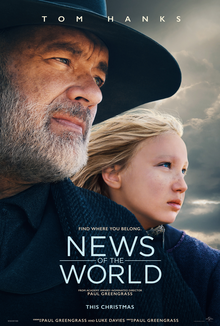
If you thought the film industry would put a halt to the traditional period epic Oscar contender in the wake of widespread theater closures, think again. Paul Greengrass' 19th century western "News of the World" arrives in the nick of time for the December holiday season. And yet, it could also be appropriate to say that it arrives too late, representing entertaining but old-fashioned filmmaking that feels like an outdated throwback to the prestige films of the past.
Set in the post-civil war South, "News of the World" follows Captain Jefferson Kyle Kidd (Tom Hanks), a war veteran who now makes a living from touring through small towns to read the latest newspapers to captive audiences. During one such trip through Texas, he stumbles on a young girl (Helena Zengel) alone in the wild who is unable to speak English. Upon reviewing documents accompanying her, Captain Kidd learns that she is of German descent but was taken by the native Kiowan people after her family was murdered. Further instructions reveal a surviving aunt and uncle, her only remaining family. Feeling obligated to protect her, Kidd embarks on a journey to brave hostile terrain and humans alike to restore her to civilization.
Adapted from a novel and mounted on a grand scale with a lovable movie star, "News of the World" is indeed a throwback to the classic adventures of yesteryear. From Dariusz Wolski's glorious wide shots, to James Newton Howard's heartstring-tugging score, to its unchallenging screenplay, there's a familiarity to its storytelling. And with Greengrass at the helm, the requisite shootouts and environmental dangers are depicted with his trademark intensity.
While the virtuosity of the production values will leave you feeling nostalgic for the Golden Age epics, the film is perhaps even more resonant as another relic of old Hollywood - the star vehicle. In her first American role, Helena Zengel's tenacity will surely be praised as a revelation (despite recalling the same unruliness displayed in 2019's "System Crasher"). But it is Tom Hanks' noble screen presence that will captivate audiences and smooths over some of the screenplay's flaws. Namely, there's a simplistic morality of the screenplay that leads to predictability and a lack of complexity to the film's obvious heroes and villains. Furthermore, it fails to fully reckon with the economic and racial tensions of the time period and setting.
And yet, there's a sense of comfort that comes from witnessing a story so carefully crafted around an actor's persona. From the very first scene, you know he'll do the right thing and win your heart. Heroic westerns may be going out of style, but a good Tom Hanks performance is timeless.
| Tweet |
Monday, December 21, 2020
REVIEW: Promising Young Woman
| Tweet |
Saturday, November 28, 2020
REVIEW: Nomadland
Much ado has been made over the past decade about the supposed neglect of Middle America - or more condescendingly, "real America" - by the "coastal elites" and "liberal media". During his election campaigns and presidency, Donald Trump pandered to the beliefs that immigrants were stealing jobs and contributing to a culture of "immoral" progressive values over conservative tradition. And yet, one of the most beautifully empathetic films about the working class struggle was directed by a Chinese woman based in Los Angeles. In "Nomadland", Chloe Zhao takes audiences on a breathtaking journey into America's heartland, exploring the perspective of one woman and her newfound way of life.
Indeed, Fern (Frances McDormand) knows a thing or two about the blue-collar lifestyle. She spent much of her life in a factory town established around US Gypsum, a manufacturer of sheetrock and other construction materials. In the wake of the recession, however, the plant shuts down, leaving the residents of Empire, Nevada bereft. Exacerbated by the death of her husband, a company man, Fern thus finds herself unmoored. Fueled by her innate will to live and pick up the pieces, she then musters the courage to embark on adventure through the American West, living out of her van as a modern nomad.
The power and impact of large corporations is acutely felt through "Nomadland." Apart from US Gypsum, the historically successful Amazon company looms large over this story as one of the main sources of employment for Fern and some of the people she meets along the way. Drawing attention to Amazon and its recognizable signage - as opposed to an unnamed or fictional company - Zhao shrewdly places "Nomadland" within the present day. And if there is anything we learned in 2020, is that America prioritizes the economy and big businesses above all else.
What makes "Nomadland" so special therefore, is how it functions as a reclamation of America from its capitalist ideals and focuses instead on the people whose livelihoods often depend on the production line. Indeed, many of the nomads Fern encounters have been "workhorses" as one man puts it . Brimming with stories about their life experiences, we listen to them around campfires and chance meetings across the vast terrain of Fern's quest.
"Nomadland" isn't the first film to center a narrative on people who have chosen an unconventional lifestyle. But Zhao's simple, yet profound vision outshines them through its relatability. Fern isn't trying to "find herself" or reject modern society and technology like a counterculture hippie. Her desire is to reconnect with other people and restore the pleasures of nature and friendship to her life.
What results is a story that is both personal and universal, told with the heartfelt, plainspoken authenticity of a documentary approach. You don't need to do any research to learn that many of the supporting characters are non-actors and real life nomads. And their naturalism is shared by McDormand in an exceptionally lived-in performance. Effectively acting as a surrogate for Zhao and the audience, her performance is largely reactive, filled with moments of active listening. Completely lacking in vanity, she finds real depths of emotion and feeling.
Aside from the touching humanity on display, what elevates "Nomadland" into the realm of the sublime is the supplemental artistry that Zhao and her craftsmen lend to the narrative. Most notably, Ludovic Einaudi's serene music - taken from his album "Seven Days Walking" - and Joshua James Richards' majestic cinematography, which takes full advantage of natural light to accentuate the preciousness of community and the effortless beauty of the American landscape. "Nomadland" may not convince you to drop everything and become a wandering nomad, nor does it ask you to. But its exhortation to embrace the simple things in spite of the pain of grief and suffering is deeply moving.
| Tweet |
Tuesday, November 24, 2020
REVIEW: Minari
With his duly award-winning new feature "Minari", filmmaker Lee Isaac Chung has delivered one of 2020's quintessentially American stories. Based on his own childhood experiences, it follows a Korean-American family as they settle into their new home in Arkansas. At once a classic and undeniably contemporary immigrant drama, this special film is a touchingly empathetic piece of storytelling.
Indeed, while its 1980s setting and Korean characters point towards more recent waves of immigration, the opening scenes of "Minari" harken back to the first settlers on the American frontier. As the Yi family make their way towards their new land in the middle of nowhere, the promise of a vast land of plenty awaits. Adapting Western iconography, however, the iconic horse-drawn wagons and homesteads are replaced by a family sedan, moving truck and mobile home. Having abandoned the city life of their previous LA abode, the family's patriarch Jacob (Steven Yuen) has big dreams for his new farmland. But this modest small town life may prove to be too much of a culture shock for his wife (played by Han Ye-ri) and their two young children.
The American Dream indeed looks different for each family, all of whom fall on various spectrums of American assimilation. With his desire to build a thriving farm of Korean produce, Jacob is the model of the traditional economic migrant. He clings to his culture while forging an optimistic future through hard work, discipline and sacrifice. The rest of his family, however, are more inclined towards the immediate comforts of a more urban lifestyle.
The tensions between their viewpoints is what propels Chung's wonderfully humane script, illuminated through fully realized performances from the cast. The partnership and understanding subtly conveyed by Yuen and Ye-ri for example, makes their widening rift all the more heartbreaking. Meanwhile, the inversely burgeoning relationship between David and his newly arrived grandmother becomes the heart of the film.
With easily the year's most adorable child performance so far, Chung uses his surrogate David (played by Alan Kim) to explore both the humor and poignancy of growing up as a confused first generation immigrant. As he inbibes his "mountain water" (i.e. Mountain Dew), he laments the fact that Soon-ja (Youn Yuh-jung) is not a "real grandmother" who cooks and bakes cookies. But before long, they become the best of friends, with their scenes together providing some of the film's most heartrending emotions.
Though its sunny photography and largely welcoming community - a major relief considering rural red state setting - may fool you into thinking otherwise, the Yi family will face their share of struggles. But what "Minari" beautifully portrays is how family and friendship can enrich the simplest ways of life, where a weekly church service represents the only significant social activity. In its unique way, "Minari" therefore celebrates the often underappreciated shared humanity between the immigrant experience and small town America.
| Tweet |
Friday, November 20, 2020
REVIEW: Ma Rainey's Black Bottom
| Tweet |
Tuesday, October 20, 2020
REVIEW: The Trial of the Chicago 7
| Tweet |
Tuesday, October 13, 2020
REVIEW: Dick Johnson is Dead
The COVID-19 pandemic is never mentioned in "Dick Johnson is Dead", the latest documentary from cinematographer-turned-director Kirsten Johnson. Yet I couldn't help but think about the virus throughout this extraordinary film that explores aging and mortality. As many of the world's leaders have attempted to offer solace in the fact the virus will mostly prove fatal "only" for older populations, "Dick Johnson is Dead" reminds us that these loved ones are as precious as anyone else.
| Tweet |
Thursday, September 3, 2020
REVIEW: Mulan
There's a common saying that you don't know what you have until it's gone. And during this historic COVID-19 pandemic, that sentiment has proven true with the closure of cinemas and the postponement of highly anticipated film releases. But thankfully, the mighty Walt Disney Company has stepped up to quell some of our fears over the future of cinema. With the arrival of "Mulan" on its Disney+ streaming platform, audiences can be reminded of the eye-catching Hollywood production values we've come to know and love. | Tweet |
Friday, August 28, 2020
REVIEW: Epicentro
If you asked a random sample of individuals to define a utopia, you'd probably get an array of differing opinions. Indeed, the means to achieving this elusive concept has been an eternal debate, exemplified by recent statements at the Republican Convention. During a speech made by Sen. Tim Scott, he decried the Democratic Party's desire to turn America into a "socialist utopia" rather than maintaining the capitalist status quo. | Tweet |