Showing posts with label Best Original Screenplay. Show all posts

Thursday, January 30, 2020

OSCAR WATCH: 1917


With dozens of films dedicated to the subject, every announcement of a WWI comes with a feeling of "been there, done that." But in the ambitious hands of director Sam Mendes, the "war to end all wars" gets a new perspective. Filmed to convey one single take, "1917" is a mind boggling cinematic achievement. But at what cost?

The premise of "1917" is relatively simple. Two British soldiers are tasked with delivering a message to a distant battalion, in the hopes of calling off an attack after intelligence indicates that a deadly trap has orchestrated by the rival Germans. The rescue mission will thus take them through dangerous enemy territory, with very artillery support. But though it seems impossible, the men are driven by an additional motivation, as a brother is among the endangered battalion they hope to save before it's too late.

As our protagonists proceed on their harrowing journey, "1917" is an impressive showcase of filmmaking techniques. Most obviously, the cinematography amplifies the stakes, giving the illusion of real time action. But while the camerawork is the star, it would be ineffective without exceptional work from the actors, composer, production designer and editor. Indeed, George Mackay and Dean-Charles Chapman are unwavering in their physicality demanding lead roles. The stirring music is deployed judiciously and impactfully. The world-building of the sets are downright incredible, particularly in giving a visceral sense of the omnipresence of death through human and animal carcasses, rodents and flies. And of course, the editor deserves highest praise for making it all feel so seamless and forcing the audience to constantly wonder, "How did they do that?"

It's therefore hard to argue against the film's 10 Oscar nominations, namely Best Picture, Best Director, Best Original Screenplay, Best Sound Editing, Best Sound Mixing, Best Production Design, Best Cinematography, Best Original Score, Best Visual Effects and Best Makeup & Hairstyling. And yet, despite my admiration for the filmmaking, I rarely felt truly emotionally connected to the story and the soldiers' plight. Even in the intentionality sentimental moments, the "obstacle course" style of the storytelling hardly gave room for the film to contemplate the characters' humanity. In the end, I was reminded of Martin Scorcese's criticisms of Marvel movies as theme parks. Despite the technical mastery on display, "1917" lacks the gravitas to be a truly great war film. Those who fought in WWI are often referred to as "The Lost Generation." It's a shame that this tribute to their efforts falls short of making them unforgettable.

Wednesday, December 11, 2019

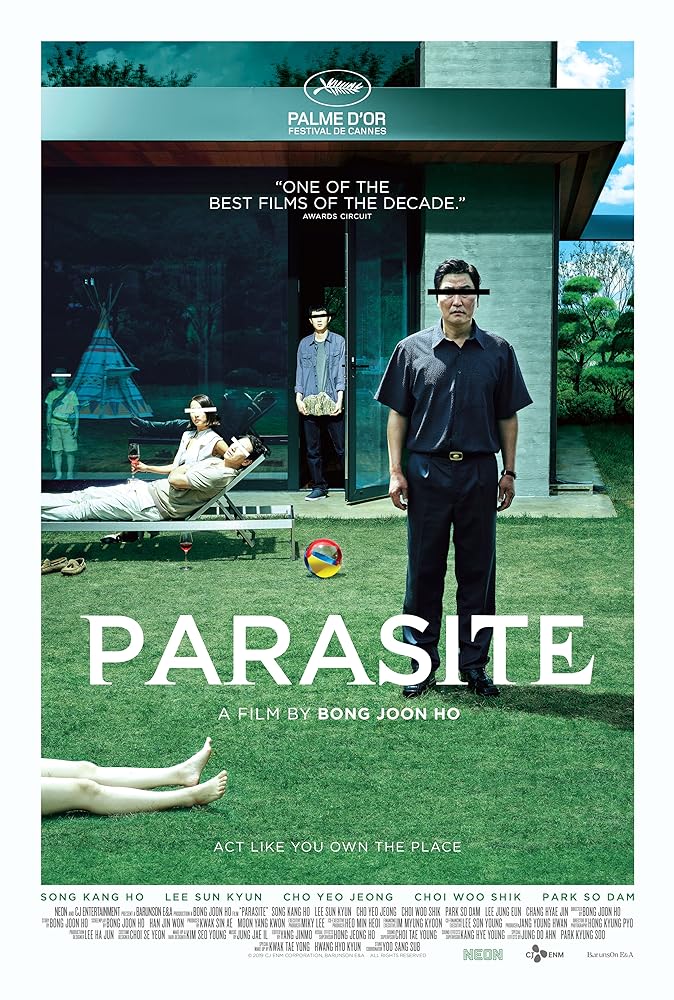
OSCAR WATCH: Parasite


Of all the memorable movie moments of 2019, there's one in particular that I haven't been able to shake. It comes in a climactic scene in Bong Joon-ho's ingenious social satire "Parasite", as class revolt within the narrative comes to ahead in response to a insulting gesture. Though the film pits the %1 against the disadvantaged poor, this scene's power comes from the way it forces middle class audiences to confront our own insensitivities.

Elaborating further on the scene would unfortunately ruin one of the film's key attributes. Indeed, "Parasite" succeeds largely on its suspenseful and utterly unpredictable screenplay. While its premise may seem like a variation of Robin Hood's "stealing from the rich to give to the poor" premise, it reveals much deeper levels as the plot unfolds.

The story surrounds two families, the wealthy Parks and the unemployed Kims. Desperate to find work, they get a lifeline when the son Ki-woo secures a tutoring job for the Parks, through the recommendation of a friend. Ever the opportunist, his arrival at their upscale home quickly sets off a light bulb in his head. Before long, he schemes to get the rest of his family to infiltrate the home by offering various household services. But the Park home harbors secrets which could completely derail their plans.

Bringing new meaning to social hierarchy with its darkly comic take on the "upstairs, downstairs trope", Bong Joon-ho's "Parasite" offers an incisive critique of class in South Korea. Much like his previous genre-inflected social satire "Snowpiercer", Bong Joon-ho uses entertaining scenarios to convey his message. As the Kims speedily take advantage of the opportunities presented to them, "Parasite" is crafted with the blistering pacing and brilliant dialogue to match. And through the efforts of a superb ensemble, the personas they embody further emphasize the wide chasm between the classes. As the mother of the Kim clan remarks of her aloof Park counterpart, she is "nice because she's rich."

As the plot twists and turns to thrilling effect, Bong Joon Ho never loses sight of the film's central anti-capitalist themes. Conveyed visually and verbally with the utmost panache, the result is a film which is universally relevant and impactful. It's therefore no surprise that it's receiving serious Oscar consideration for Best Picture, Best Director, Best Original Screenplay, Best Editing, Best Production Design and Best International Feature. With its strong social commentary and thrilling storytelling,  "Parasite" is truly one of the year's must-see films.

Friday, December 6, 2019

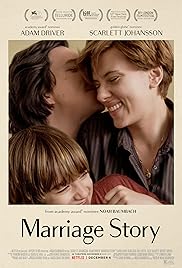
OSCAR WATCH: Marriage Story


The most toxic relationships are the ones you don't even realize as such, until hindsight makes you see things clearly. That's the lesson Nicole and Charlie learn in "Marriage Story", the exceptional new drama from Noah Baumbach. Stunningly portrayed by Scarlett Johansson and Adam Driver, this Best Picture Oscar hopeful conveys honest truths about love, marriage and divorce.

We first meet the embattled couple - Nicole, a up-and-coming actress and Charlie, a hotshot theatre director - during a mediation session, as both have decided to split amicably, in the best interest of themselves and their child. When the therapist asks them to list the positive things about their partner, however, Nicole suddenly realizes that she's harboring deeper feelings of pain than she initially suspected. Subsequently, she uproots her New York life - and their son Henry - to return to Los Angeles and be with her mom. But the pressures of long-distance parenting puts a strain on their civil friendship. Though they had agreed to forego legal proceedings, a heated divorce case and custody battle ensues.

The messiness of divorce is put in a sharp focus as Baumbauch's perceptive screenplay unleashes the myriad of emotions associated with it. As Nicole tries to rationalize the reasons for the split, the film gets to the truth of how willfully one-sided relationships can be, as the hopes and dreams of one partner become subsumed into the other's. It is often said that married people gradually begin to look like one another and "Marriage Story" poignantly conveys that "oneness" and loss of self.

Smartly, the script balances both perspectives, also showing how Charlie's ambition and pride caused him to neglect his wife's needs and to a certain extent, his own. Indeed, the nuances of both characters' personalities are brilliantly elaborated through many relatable moments littered throughout. I'm sure many audiences can relate to the hate-filled outbursts you instantly regret, as well as the subconscious competitiveness and selfishness that can erode a relationship over time.

While Johannson and Driver (slam dunk Best Actor and Best Actress nominees) show incredible vulnerability as the leads, the rest of the scintillating cast is equally as riveting. Laura Dern is particularly compelling as Nicole's self-assured lawyer who fights for her client like a bulldog with a smile. After two nominations throughout her career, she may have finally earned her first Oscar for Best Supporting Actress for her work here.

Dern's delicious performance embodies one of the film's most winning touches, namely it's frequent moments of levity. Indeed, Baumbach deserves every Best Director and Best Original Screenplay accolade he'll receive during this awards season for his masterful juggling act of humor and pathos. Punctuating the narrative with music, situational comedy and delightful bit roles (Merritt Wever and Julie Hagerty are terrific as Nicole's sister and mother), it serves as a reminder that things are rarely black or white in life and relationships. As conveyed in the heartrending monologues which bookend the film, when all is said and done, sometimes the hardest truth about broken relationships is that there's still some love that remains.

Friday, September 27, 2019

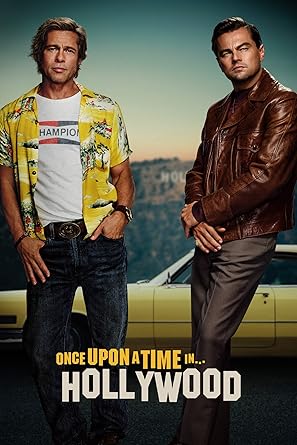
OSCAR WATCH: Once Upon a Time in Hollywood


If there's one thing that Hollywood loves is movies about movies. And if there's one filmmaker who loves making those movies, it's Quentin Tarantino. Famously known as a film nerd, Tarantino's filmography is filled with homages to film history. Whether it's the blaxploitation era in "Jackie Brown" or the spaghetti westerns in "Django Unchained", his love of cinema is always on display. You could therefore argue that his latest Best Picture contender - "Once Upon a Time in Hollywood - represents a culmination of his filmography to date. Chock full with references to classic cinema, Tarantino shows off his film literacy with a comedy-drama that educates as much as it entertains.

Indeed, "Once Upon a Time in Hollywood" is practically a crash course in classic cinema. Set during the late 1960s, it reflects the turning point when Classic Hollywood was making way for the New Hollywood movement which would emerge in the next decade. Incorporating real life figures of the time with fictional characters, the film thus follows a fading star of 1950s TV Westerns - Rick Dalton, played by Leonardo DiCaprio - who struggles to find his place in the new world order. With his trusted stunt double and closest friend Cliff Booth (Brad Pitt) by his side, he attempts a personal reinvention as a movie star. But it will prove to be his greatest challenge yet, as a growing, youthful counterculture threatens to leave him behind.

That tension between old and new hollywood is at the core of "Once Upon a Time in Hollywood", as it serves as a time capsule for a turning point in the film industry. In this regard, Tarantino instills an evocative atmosphere of 1960s Los Angeles, thanks to the music, clothing, sets, and the hair. Oscar nods for the film's aesthetic would definitely be well deserved, particularly for Best Production Design. And Quentin Tarantino will surely garner the respect of his peers in his Best Director bid.

Tarantino's attention to detail brings a tangible authenticity to the settings, augmented by playful nods to films and stars of the era, ranging from "The Great Escape" and "Rosemary's Baby" to "The Wrecking Crew". Indeed, the latter notably draws attention to the subplot involving rising star (played with eager gusto by Margot Robbie). But while initial promos highlighted the ill-fated Tate - and the murderous Manson Family plays a major role in the film - she remains more of a concept than a fully drawn character.

Ultimately, Tate's storyline becomes a casualty of a screenplay that struggles to cohere. As such, the whole is less than the sum of its parts. Thankfully, its best parts truly resonate enough (and will surely push it forward in the Best Original Screenplay race). Namely, the friendship between Dalton and Booth and the charismatic performances from DiCaprio and Pitt. Indeed, Brad Pitt is cool personified in a performance that will likely net him a Best Supporting Actor nomination. Meanwhile, DiCaprio will also garner himself yet another Best Actor nod for his outstanding work. Using every ounce of his physicality and expressive eyes, he is often self-deprecating and vulnerable as a man who must prove to himself and the world that he is a true movie star. Ironically, DiCaprio is effortlessly charismatic in the role, once again proving his movie star bona fides. And perhaps that's the essence of the film and Hollywood itself. No matter the era, it's a town built on make believe and only the most convincing imposters survive.