Friday, July 18, 2014

Caesar's ready for his close-up!


I don't post random film news very often, but this one was too good to pass up. We all know that red carpet glamour and publicity are equally as important as the actual performance when it comes to Oscar campaigns. Just look at Lupita's slaying of the red carpet last year for example. Well, it looks like the team behind "Dawn of the Planet of the Apes" are giving their star the similar treatment. Yep, Caesar is out there gracing magazine covers and putting us mere humans to shame! Many think that the Andy Serkis Oscar talk is just wishful thinking, but this is the kind of buzz that can keep him in the conversation. At the very least, the 2nd installment will hopefully rectify the shocking Visual Effects Oscar loss of its prequel.

Check out some of the shots below from Caesar's photoshoot for ShortList Magazine:

Tuesday, July 15, 2014

HIT ME WITH YOUR BEST SHOT: Batman: The Movie


Hit me with your best shot returns this week and it's a Batman celebration! For this assignment, Nathaniel had us select any of the 9 theatrically released Batman movies for our best shot. I decided to go with one that I hadn't yet seen - "Batman: The Movie" from 1966. Having now experienced this strange film, I now fully understand the extensive transformation that the comic book/superhero movie genre has undertaken.

Under the scrutiny of modern eyes, this film provides a unique challenge. It's the rare occasion where any criticism I can throw at the film could just as easily be interpreted as compliments. "Batman: The Movie" is dumb, phoney and slight...but that's exactly what they were aiming for! From the very beginning, it's clear that you shouldn't take this very seriously. The performances are just so chipper and tongue-in-cheek. Really, the events of the movie are just an elaborate private party game and you can't convince me otherwise.

Despite the relentless stupidity, it's a fun watch (that bomb disposal scene is comedic brilliance) and I eventually began to appreciate its warm embrace of its comic book origins. This lead to my pick for best shot below.

Click below for my favourite shot...

Monday, July 14, 2014

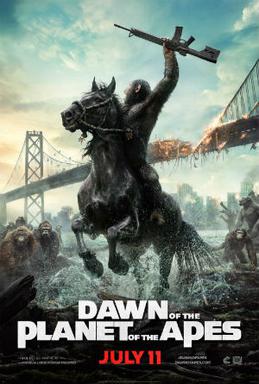
MOVIE OF THE WEEK: Dawn of the Planet of the Apes


This week's top film is one of this summer's biggest triumphs - "Dawn of the Planet of the Apes". A sequel to Rupert Wyatt's unexpected gem of 2011, this is a film that certainly had a lot to live up to. With a new director at the helm (Matt Reeves), the challenge was to repeat the thought-provoking mainstream entertainment of the predecessor. After seeing the end product, I can safely say that it achieves its goal, as this film is nothing short of a work of art.

"Dawn of the Planet of the Apes" opens with a prologue that is a stunning example of world-building. In an extended scene that recalls "The Lion King", our protagonist Caesar ushers in his newly born son into the world. It's set in a future world where scientific experiments have lead to the evolution of apes, while decimating the human race. Under the leadership of Caesar, these apes have settled into their own civilization, creating a close-knit community in the woods. They are completely separated from the few remaining humans, until one day a group of explorers discover their enclave. The meeting stirs up old resentments from both sides and much to the disappointment of Caesar, it seems like war is inevitable.

This war is the film's raison d'être. The first film was the origin story, laying the foundation for the characters and their conflicts. Now it's time to see these intelligent, powerful apes do battle with the weakened human race. Yet despite this inevitable destination, the film takes its time to get there. The audience may have come for the action, but Reeves is intent on giving us something more.

One thing that Wyatt did very well in "Rise", was to instill our empathy with the apes. It's something that Reeves latches on to quite early here and expands on tremendously throughout the narrative. The aforementioned intro is striking in its ability to show the beautiful grace and "humanity" of these evolved apes. The image of various friends/relatives caressing a mother (Caesar's wife Cornelia) as she nurtures her baby stands out in particular. The saying "it takes a village to raise a child", is one that this community clearly holds dear.

There are many striking images throughout this film, as Reeves expresses a stunning directorial vision. From start to finish I marveled at the impeccable visual storytelling on display. There's no doubt that this installment is a stronger feat of directing.

Reeves' keen eye greatly enhances the script too. With the predictability of action-oriented summer movies, one of the greatest challenges is trying to stand out amongst all the calculated studio product. Indeed, the basic concepts of this film have already been explored just from this summer alone! In "Godzilla" we saw another cautionary tale about man's effect on nature and "X-Men: Days of Future Past" delved into the apocalyptic "us vs them" scenario quite well. In this film, we get all of that with even more memorable images that are linked with deeper themes. No other summer blockbuster has conveyed the range of themes (compassion, family, loyalty) here with as much clarity and purpose.

From the fascinating interactions between man and ape (in addition to dissenting factions within these groups) to the terrifying pandemonium of the climax, the film elicits strong feelings of human shame. This may be a work of fiction, but just a glance at various high-profile documentaries like "Project Nim" and "Blackfish" will show that there's something fundamentally wrong about the way we treat animals. Those same sentiments are conveyed beautifully here, through the superb motion-capture performances of these complex ape characters. The humans are fine, but Caesar (Andy Serkis), Koba (Toby Kebbell) and Blue Eyes (Nick Thurston) are the real stars.

In "Dawn of the Planet of the Apes", Matt Reeves has created a film that improbably improves on the original in many ways. The directing, editing, visuals and acting continue to be of the highest calibre. The initial stages may feel overly solemn for a film centered around talking apes, but once it hits its stride, you'll find a film that is rich in thought and appealing aesthetics.

Sunday, July 13, 2014

A ROTTEN TOMATO: Transcendence


When coming up with my list of Most Anticipated Films of 2014, one film that stirred my interest was Wally Pfister's directorial debut "Transcendence". After years of working closely with Christopher Nolan (one of my all-time favourite directors), I figured he must have learnt something from that modern genius. Sadly, that wasn't the case as this film turned out to be a major disappointment.

On the surface, it's easy to see why Pfister would be interested in this script (a 2012 Black List honoree no less). This story about a scientist named Will Craster (Johnny Depp) whose consciousness gets uploaded into the powerful artificially intelligent computer which he created, is just the kind of material that he worked on for years with Nolan. Based on complicated science surrounding "technological singularity", it's a premise that one could envision Nolan exploring with exhilarating results. Of course, this isn't a Nolan film and Pfister's shortcomings as a director (as well as Jack Paglen's poor writing) are self-evident here.

"Transcendence" springs into motion following a lecture where Will Caster (Depp) explains his project (along with his wife Evelyn, played by Rebecca Hall) about creating sentient technology that surpasses human intelligence. In the aftermath of his presentation, he is shot in protest by a group called R.I.F.T. (Revolutionary Independence From Technology) who oppose the "godlike" intentions of the technology. Discovering that the bullet is laced with radiation poisoning, Evelyn decides to upload his consciousness to preserve his "being" before he dies. With the reluctant help of fellow researcher Max Waters (Paul Bettany), the plan works, effectively bringing Craster back to life. Hooked into our worldwide network of technology thereafter, he becomes increasingly powerful.

As with any sci-fi thriller, there are inevitable complications. It starts out well, as Will and Evelyn invest in a highly advanced technological facility in the desert, improving various fields of science, like biology, nanotechnology and medicine. However, when Evelyn realizes that his powers extend to analyzing people's minds, she realizes that they may have gone too far.

Well, she was right. Like this Transcendence project, the script overextends itself to absurdity. Mainly, it takes a lot of narrative shortcuts (like lazy usage of "X" years later to skip the explanation of the technology) that keep the audience at a distance from the core premise, no matter how fascinated you may be. For a film that is rather long (about 2 hours), there's a perplexing lack of actual "stuff" happening. By the time you reach the point where there's a fairy dust substance being dispersed throughout the world, the film starts to feel more like magical fantasy than intellectual science fiction.

Apart from these conceptual absurdities, the film's greatest offence is its false advertising. Now, I won't go as far as suing the filmmakers but a plot that involves an assassination attempt, revolutionary technology gone awry and FBI investigations, has no excuse for being this dull. In fact, one would find it difficult to even consider this a thriller, as its trailers would suggest. Throughout the film there are many mentions of impending danger, yet we see no urgent conflict until the final act. Somehow Pfister expects to keep our attention without giving us anything exciting to engage with (visually or thematically) for the majority of the running time.

To add further insult to injury, the film is capped by a Nolanesque poignant ending that is completely unearned. With little engagement with the science or the dynamics of the central romantic relationship, it leaves you annoyed rather than invigorated as clearly intended ("look, isn't this clever?"). No thanks, I'll take "Inception" and its spinning top instead.

There's no denying that making the switch from cinematography to directing is a major step, and I commend Wally Pfister for giving it a go. However, the bland outcome of this effort indicates that he may not be up to the task. The good news is that he remains a talented cinematographer, so this is just a bump in the road in an otherwise impressive filmography. Maybe with some more mentoring in the art of directing he can actually make a good film from the director's chair in the future.

Wednesday, July 9, 2014

Roger Bobb to receive 2014 Synergy Award


The African American Film Critics Association recently announced that filmmaker Roger Bobb (pictured above) will receive the organization's Synergy Award for his contributions to the Atlanta Film Industry. Read below for the full press release:

Monday, July 7, 2014

MOVIE OF THE WEEK: Non-Stop


This week's top pick is a film that was quite a surprise for me - "Non-Stop". The latest in a series of tough guy roles for Liam Neeson, many would point to this as simply another paycheck role in a disposable movie. Honestly, these assumptions are probably correct. For me though, there was something fundamentally enjoyable about this conventional cash cow.

Over the years, it seems I've developed an affinity for films and TV series involving disaster-struck planes as crucial plot element ("Lost", "Flight", "Flightplan" etc.). It's a rather strange situation, especially considering the fact that I travel often. Somehow, I find a sense of "comfort" in these scenarios, especially those where the flight dominates the plot. There's just something about the dramatic tension of those claustrophobic confines that I always respond to. Likewise, I get a cathartic thrill out of the inevitable heroic landing. At the basic level then, "Non-Stop" was bound to give me some satisfaction.

Still, there were many ways that "Non-Stop" could have gone wrong. The story is your classic whodunit mystery where one man must find the perpetrator before it's too late. In this instance that man is Liam Neeson, who plays an air marshal aboard a hijacked transatlantic flight. As expected, it all hinges on an exorbitant ransom (this time it's $150 million) that the criminal demands for rather silly reasons.

Now if you're expecting something smarter from the script then you're likely to be disappointed. However, if you can fully suspend your disbelief you'll likely find this to be an entertaining ride. The biggest draw is a compelling cast featuring talented actors like Julianne Moore, Scoot McNairy, Michelle Dockery, Nate Parker, Corey Stoll, Lupita Nyong'o (a hilariously tiny role) and of course, our resident badass Liam Neeson. They all pull their weight by keeping you engaged with the characters and their plight.

The film is also well-paced, with hardly a dull moment as Neeson tries to solve the mystery. The script behind this mystery may not be extraordinary, but there's something gratifying about its lack of ambition. Sometimes a film's ability to simply avoid being "bad" (rather than strive for greatness) can make for some of the most rewarding experiences. A number of this year's summer movies seem to be succeeding largely because of this reason ("Edge of Tomorrow" for example) and I think the same applies to this earlier release.

Like many other films of its ilk, "Non-Stop" will undoubtedly leave you scratching your head at the motivations behind the climactic reveal. What separates it from those countless other failures however, is its ability to keep you constantly entertained so those ridiculous plot twists don't matter. Really, with Liam Neeson in top form, what's there to complain about?

Saturday, July 5, 2014

A ROTTEN TOMATO: G.B.F.


Earlier this week, I commented on the propensity for moviemaking trends to repeat themselves in terms of the scale of blockbusters. Upon watching the 2014 film "G.B.F." (an acronym for gay best friend), I'm now also reminded of the propensity for filmmakers to borrow elements from other films that came before. In the case of this film, it's the highly regarded "Mean Girls" of 10 years prior from which it draws its influences. Unfortunately, in trying to replicate that film's success, "G.B.F." fails to carve out its own identity, even though its premise suggests something new.

Said premise of "G.B.F." is a high school coming out story. It centers around a reserved young man named Tanner (Michael J. Willett), who reluctantly gets outed by his school's Gay-Student Alliance in their quest to recruit the first gay person into their club. Unfortunately for them, a trio of popular girls have other plans. As prom night approaches, they all compete for Tanner's affections, hoping that a gay best friend will increase their chances of winning prom queen. Unable to settle it fairly, they devise a win-win situation where Tanner befriends all three in exchange for protection from the school bullies. Of course, complications arise as the girls struggle to share their new accessory and Tanner's new clique puts a strain on his relationship with his former best friends (one of whom is also gay).

On paper it all sounds like a fresh perspective on the high school comedy, placing a gay character front and center. It seemed like an opportunity for some interesting insight into the young gay perspective but sadly, the film feels like a rehash of storylines we've seen before. The most apparent comparison is of course, "Mean Girls". There are similar plot points and the characters are almost the same - a "fish out of water" protagonist, three popular girls (the pretty but mean queen bee, the ditzy one and the undervalued one who's jealous of the queen bee), the unpopular best friends and the concerned teacher with a heart of gold. It doesn't help that the film also actively acknowledges "Mean Girls" too, referencing Lindsay Lohan and the "things I've learned" prom speech.

Sadly, the film didn't steal any of that film's finer qualities outside of its basic structure. From the first scene there's a fakeness to the setting that makes the film hard to take seriously. There's just no sense of place (sometimes it feels like a liberal northeast school and other times it could pass for a conservative red state). It also lacks visual flair, with hardly any physical comedy to stimulate the senses. Sorry George Northy (the screenwriter), but there's nothing inherently funny about two gay boys having a private bedroom dance party. Without the sight gags, it tries to compensate with the writing, but it lacks the invaluable wit that Tina Fey gave to her film. I can count the funny lines of dialogue on a single hand. As such, everything just falls flat and that includes our protagonist. One could argue that Willett's bland acting is intentional (he doesn't conform to the effervescent gay stereotype) but he seriously brings down the film's energy.

Tanner's dullness further exacerbates the film's "Mean Girls" problem. Specifically, the most intriguing characters end up being the three girls rather than the central character. Queen Bee Fawcett is smarter than she appears, token black girl Caprice is a champion of equality and Shley is a conservative Mormon girl who proves to be surprisingly tolerant and adventurous. They all have more depth than Tanner, who's only defining characteristic seems to be his sexuality. Yet still, the writing refuses to commit to these characters, only allowing Fawcett to get full character development. There's a fascinating opportunity with Caprice (at one point she's offensively referred to as a sassy black friend) to mirror Tanner's experience with societal pigeonholing, but it's never properly explored. Meanwhile Shley is saddled with all the narrative cliches of being ditzy, drunk and sexually frustrated. It's evident that the script should have narrowed its focus on either the gay teen's coming of age or the politics of high school girls running for prom queen.

There's a worthwhile story to be told from the idea of "G.B.F.", but this film fails to deliver it. Instead, this is nothing more than a poor man's "Mean Girls". If you count yourself as one of the many fans of that film, then I'd recommend watching that rather than wasting your time with this uninspired effort.

Monday, June 30, 2014

MOVIE OF THE WEEK: Cleopatra


As critics and cinephiles bemoan the arrival of the latest Transformers film, it's probably as good a time as any to reflect on Hollywood's history with the "bigger is better" mantra. This week I took on the daunting task of watching 1963's "Cleopatra", a big budget epic starring Elizabeth Taylor that runs nearly 4 hours. Much like today's blockbuster obsession, the film was part of a trend of large-scale visual spectacles dominating the box office (at the time these were mainly lavish musicals and historical epics). History seems to be repeating itself then, as "Cleopatra" is known for its striking visuals that mask the shortcomings of its script.

"Cleopatra" is perhaps best summed up by a pair of quotes found within the film itself. Together they concisely capture the film's strong points, as well as its nagging flaws. It's a pity that Joseph L. Mankiewicz (director and co-writer) wasn't self-critical enough to craft a more compelling film.

The first quote comes very early in the film. Julius Caesar (Rex Harrison), a Roman general and Cleopatra's initial paramour, goes to meet the young Pharaoh Ptolemy XIII in Egypt as part of war negotiations. Upon arrival, Caesar approaches the Pharaoh's entourage and quickly makes note of these curious people. Noticing their elaborate attire, he exclaims "You all look so impressive. Any one of you could be king." This is delivered as a throwaway scoff, but it turns out to be an almost self-aware acknowledgement of the film's Modus operandi. Much of the film's value is derived from its impressive visual spectacle, a quality that hasn't diminished over the years. The production design is staggering to behold (filmmakers wouldn't dare to construct all those elaborate sets today). A grand procession for Cleopatra in particular can only be described as "monstrous". Perched atop a giant Pharaoh float, pulled by hundreds of servants, it's a scene that defines the film's audacity (and it's record-making budget).

Likewise, the impressive costumes mentioned earlier are also awe-inspiring. The main attraction of course, are the outfits (about 65 costumes in total) given to the film's titular character alone. Costume designer Renié did some truly remarkable work, clothing Elizabeth Taylor in stunningly flattering gowns that left no doubt as to the notorious sexual allure of Cleopatra, as mentioned by the men in the film.

So where did this visual feast falter? The second insightful quote (uttered during that same extravagant procession) would seem to address this. One of Caesar's right-hand men remarks to him, "The queen has given instructions for the procession to move as slowly as the people wish, for their full enjoyment." Presumably unintentional, this line reflects the film's "double-edged sword". Indeed, there's much enjoyment to be had in the showmanship of the production values, but the bottom line is that the film becomes increasingly slow and tedious. After the climactic events surrounding what is popularly known as the Ides of March, the film struggles to sustain any momentum. Much of the second half involves indoor political scheming and the actors (namely Richard Burton and Elizabeth Taylor) fail to elevate the dull material. By the time we reach the Battle of Actium, the film has already lost most of our interest.

Taylor in particular is egregiously shortchanged by the script. Quick historical research would indicate that Cleopatra was legendary for her political acumen, yet the film relies more on the sex appeal which allowed her to align herself with powerful men. Taylor is certainly very striking and attractive in the film, but she never convinces you of her leadership skills. Whether that's the poor writing or just her failure to fully grasp the character is up to interpretation. Either way, when such a major film is dedicated to the presumably extraordinary life of a historical world leader, one would expect to see more than just confidence and cleavage.

When all was said and done, the film was a box office hit, but its massive budget almost bankrupted the studio. Of course, Fox was soon saved by the success of "The Sound of Music" but the stain of "Cleopatra" still lingered. As Mark Harris pointed out in his superb book "Pictures at a Revolution: Five Movies and the Birth of the New Hollywood", even the filmmakers of films like Cleopatra felt uncomfortable defending them as creative enterprises. Suffice it to say, the seemingly contemporary outcry over "the death of cinema" has probably been going on for decades. The blockbuster factory is just a by-product of Hollwood's profit-making business model. It may not promote great "art", but it seems to satisfy the consumers. Today's "The Lone Ranger" is yesteryear's "Cleopatra". Even in their failures, there's something appealing about them. As someone on twitter explained to me, "Cleopatra" is a must-see for the sheer spectacle.

Wednesday, June 25, 2014

COMING SOON: Boyhood

Will we be seeing our first Best Picture contender as early as next month? Some pundits seem to think so with regards to Richard Linklater's "Boyhood". Personally, I'm just excited to experience this monumental 12-year achievement, regardless of awards. Hopefully I get to see it sooner rather than later. Check out the trailer below.


Boyhood hits theaters on July 11th.

Monday, June 23, 2014

MOVIE OF THE WEEK: The Man Who Shot Liberty Valance


This week's pick for "Movie of the Week" is a film by one of the Great American directors. "The Man Who Shot Liberty Valance" was
directed by John Ford and released in 1962 during the twilight of his career. After years of making some of the best classic Westerns, this film marked something of departure for Ford, paving the way for a new era of revisionist Westerns.

The film begins in the aftermath of the plot's main events. We are introduced to a man named Ransom Stoddard (James Stewart) and his wife (Vera Miles), arriving by train to attend a funeral. Stoddard is obviously a respected senator with strong ties to this small Western town of Shinbone. When a reporter asks Stoddard to explain his reasoning for traveling all the way from Washington, we get the full story of "The Man Who Shot Liberty Vallance".

As I approached the film, I was already wary of the usual plot devices. I'm not a big fan of the traditional Western and its revenge-obsessed notions of honor and justice, and this film seemed susceptible to head down that path. Under the direction of the man who practically legitimized the genre and starring its most famous star (John Wayne), what else was I to expect? Well, I'm happy to report that I was proven wrong.

"The Man Who Shot Liberty Valance" is almost experimental in its design. It seems borne out of curiosity, wondering what would happen if George Bailey or Jefferson Smith (iconic Jimmy Stewart characters in Capra films) were transplanted to the wild West? It was probably a strange proposition at the time, but it produced fascinating results. This is vintage Jimmy Stewart, the model upstanding citizen, but this time transplanted into a rough, violent world. His Ransom Stoddard sticks out like a sore thumb (that earnest voice is fully intact), but he serves a purpose, both for the filmmaker and the story itself.

Ransom Stoddard starts out as a lawyer, hoping to set up a practice in Shinbone. He gets a rude awakening however, as his stagecoach is robbed upon arrival by a violent outlaw named Liberty Valance. Upon realizing that Stoddard is a lawyer, Valance teaches him a lesson in "Western" law, mercilessly whipping him to near death.

Shaken but not deterred, Stoddard vows to uphold his values, challenging the society's lawless, violent ways. It's a risky proposition, due to a cowardly marshal and a community too afraid to stand up for justice. Eventually, Stoddard himself is corrupted by the ways of the land, opting to purchase a gun after further harassment by Valance and his gang.

Due to its mostly indoor settings, Ford doesn't get the chance to flaunt his trademark landscape photography here. Instead, the film is more internal, in terms of both the indoor setting and its psychological debates. Whereas traditional Westerns touted violent retaliation as a natural solution, Ford uses Stewart/Stoddard to challenge the ideal.

As always, John Wayne represents the old method of "shoot first, ask questions later", mocking Stoddard as an idealistic "pilgrim". When Stoddard succumbs to the pressure then (buying a gun), it's hard not to feel disappointed. The mythology of Jimmy Stewart saving the day proves to be no match for the brutal world of the Western. So even as Ford critiques the violence, he realized that some circumstances required it, as evidenced by the film's title.

All of this seems strikingly relevant today, in light of the ongoing discussion surrounding gun control in America. As these Westerns and actual history would attest, the United States was built on a violent foundation. It's therefore no surprise that so many are clinging to the 2nd Amendment in the name of self-defense. Ford understood this, as Stoddard's eventual political career is launched not by his intelligence and community service, but rather a perceived gun-slinging reputation that he reluctantly subscribed to. In the end, the film is therefore not completely revisionist (romanticized violence is still the main fix), but its use of Jimmy Stewart as the protagonist was a brilliant move in subverting the expectations of a Western hero.

"The Man Shot Liberty Valance" gives you all the usual qualities of a great John Ford film - talented cast, good script, strong cinematography, smart direction. However, this is a case where the film's themes and social implications transcend the actual filmmaking. It's a well-made film, but more importantly it challenges your expectations of cinema. It's certainly worthy of its preservation in the National Film Registry, fulfilling the criteria of being "culturally, historically, or aesthetically significant".