Showing posts with label Best Sound Mixing. Show all posts

Thursday, January 30, 2020

OSCAR WATCH: 1917


With dozens of films dedicated to the subject, every announcement of a WWI comes with a feeling of "been there, done that." But in the ambitious hands of director Sam Mendes, the "war to end all wars" gets a new perspective. Filmed to convey one single take, "1917" is a mind boggling cinematic achievement. But at what cost?

The premise of "1917" is relatively simple. Two British soldiers are tasked with delivering a message to a distant battalion, in the hopes of calling off an attack after intelligence indicates that a deadly trap has orchestrated by the rival Germans. The rescue mission will thus take them through dangerous enemy territory, with very artillery support. But though it seems impossible, the men are driven by an additional motivation, as a brother is among the endangered battalion they hope to save before it's too late.

As our protagonists proceed on their harrowing journey, "1917" is an impressive showcase of filmmaking techniques. Most obviously, the cinematography amplifies the stakes, giving the illusion of real time action. But while the camerawork is the star, it would be ineffective without exceptional work from the actors, composer, production designer and editor. Indeed, George Mackay and Dean-Charles Chapman are unwavering in their physicality demanding lead roles. The stirring music is deployed judiciously and impactfully. The world-building of the sets are downright incredible, particularly in giving a visceral sense of the omnipresence of death through human and animal carcasses, rodents and flies. And of course, the editor deserves highest praise for making it all feel so seamless and forcing the audience to constantly wonder, "How did they do that?"

It's therefore hard to argue against the film's 10 Oscar nominations, namely Best Picture, Best Director, Best Original Screenplay, Best Sound Editing, Best Sound Mixing, Best Production Design, Best Cinematography, Best Original Score, Best Visual Effects and Best Makeup & Hairstyling. And yet, despite my admiration for the filmmaking, I rarely felt truly emotionally connected to the story and the soldiers' plight. Even in the intentionality sentimental moments, the "obstacle course" style of the storytelling hardly gave room for the film to contemplate the characters' humanity. In the end, I was reminded of Martin Scorcese's criticisms of Marvel movies as theme parks. Despite the technical mastery on display, "1917" lacks the gravitas to be a truly great war film. Those who fought in WWI are often referred to as "The Lost Generation." It's a shame that this tribute to their efforts falls short of making them unforgettable.

Tuesday, November 26, 2019

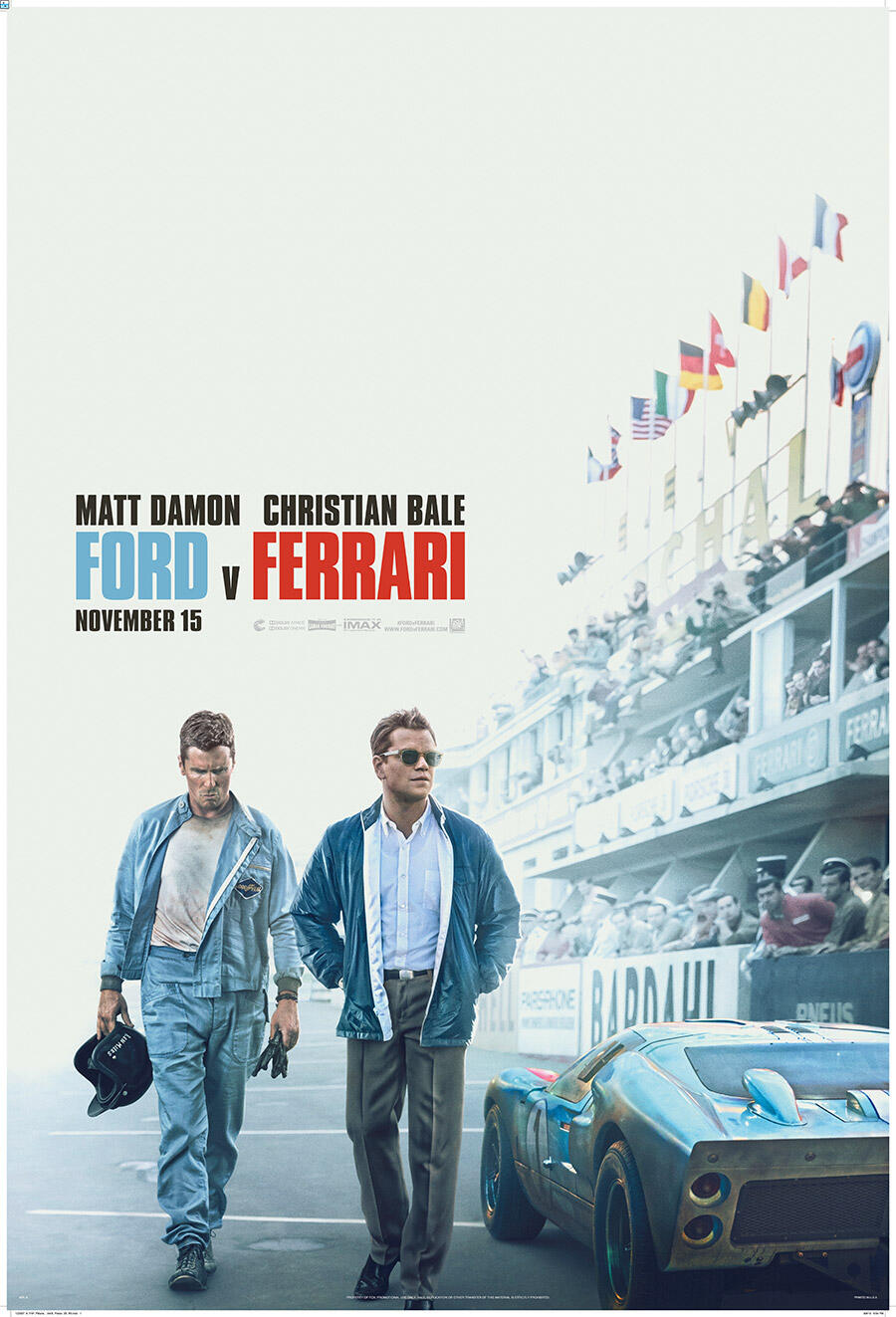
OSCAR WATCH: Ford v Ferrari


As Henry Ford II - aptly portrayed with gruff egomania by Tracy Letts - proudly reminds us in "Ford v Ferrari", the invention of the automobile (especially those made by Ford) completely revolutionized modern society. In the proceeding decades, a love affair with cars has been a staple element of consumerism, particularly for men. Today, those earliest wagon-esque models have evolved into sleek sports cars, prompting an obsessive "need for speed" as chronicled in this gripping new film from director James Mangold.

As the title suggests, "Ford v Ferrari" depicts the true story of the battle between rival automotive makers Ford and Ferrari. Representing the best of American and Italian innovation, they were at the forefront of the industry, with Ford representing the populist choice for everyday consumers and Ferrari representing the cutting edge of speed-oriented technology. As the 1970s approached however, Ford began to feel its influence fading. New generations craved forward-thinking style and sophistication, rather than boxy models that came before. So Ford hatches a daring plan to design a car to beat Ferrari on their most dominant stage - the 24 Hours of Le Mans race in France. Under the advice of a determined automotive designer/engineer named Carroll Shelby (Matt Damon) and his unpredictable but extraordinary driver Ken Miles (Christian Bale), they set out to secure bragging rights and ensure the viability of the company.

Unsurprisingly, "Ford v Ferrari" shines brightest when its on the race track, appropriately delivering edge-of-your-seat thrills with slick production values and nail-biting stakes. The film will surely figure into the Oscar races for Best Sound Mixing, Best Sound Editing and Best Editing. It gives you a visceral sense of the power of these cars and the real dangers being faced every time someone gets behind the wheel.

Indeed, while the film duly indulges the male fantasy of automotive prowess, the more unexpected grace notes are its elegant screenplay and strong character development. As the wily Ken Miles, Christian Bale turns in a performance as finely tuned as his souped-up Ford, combining lived-in naturalism with a distinctive persona. Likewise, Matt Damon's monologues about the existentialist experience of driving a car are a highlight of the film. If "Ford v Ferrari" were to net an Oscar nod for Best Original Screenplay, it would be due in large part to his eloquence.

Ultimately, "Ford v Ferrari" succeeds for its sincere empathy towards the relationships between men and their cars, and each other. Its depiction of masculinity, pride and male friendship feels authentic to the way men express their feelings. As the plot races to the finish line, those withdrawn emotions will likely catch up with you. For all its masculine bravado, this Best Picture contender turns out to be one of the most heartfelt films of the year.